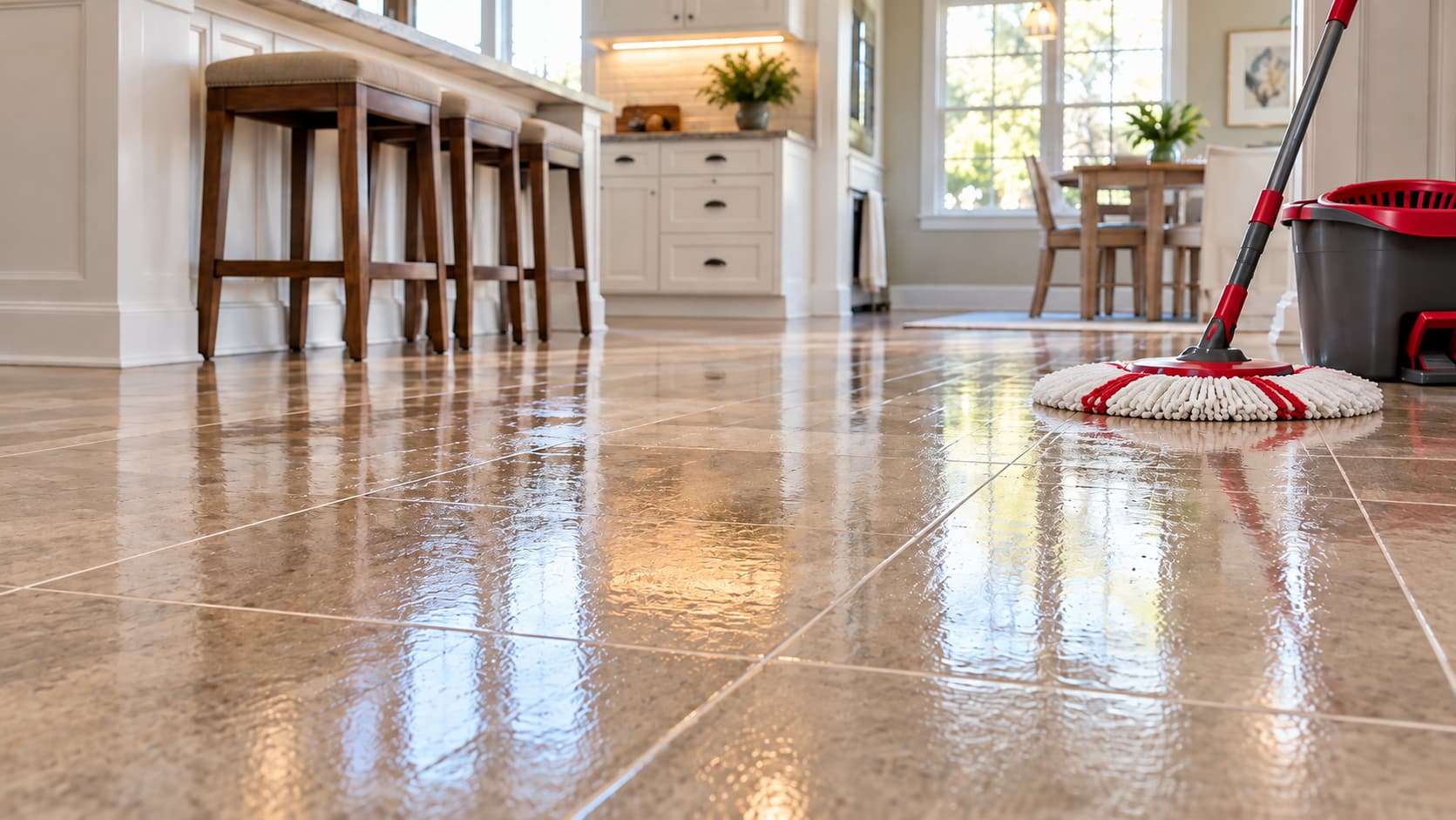
The Swiffer PowerMop promises to make mopping easier. No bucket to fill, no dirty water to empty, and no mop heads to wash. Just spray, mop, and throw away the pad.
It sounds great, doesn’t it?
At The Little Mop, we usually rely on a traditional microfibre spin mop from Vileda. However, we do occasionally use a Swiffer PowerMop at a client’s request or when the job calls for it.
And while the PowerMop has its advantages, we find that a spin mop does a much better job of actually cleaning floors.
Here’s how the two compare and when we’d recommend using each.
Why we prefer a spin mop for cleaning floors
A spin mop has a thick, absorbent microfibre head that you can rinse as often as needed in a bucket of water. You can tackle a dirty area, rinse the mop, wring it out, and carry on with a cleaner mop head.
The Swiffer PowerMop sprays cleaning solution onto the floor, which you then wipe up with a disposable pad. Those pads have textured strips to help loosen dirt, but you can’t rinse them out as you work.
In our experience, a spin mop is noticeably better at tackling built-up dirt and grime, particularly when cleaning an entire room rather than a small spill.
Being able to use warm water (depending on the surface, of course) also helps loosen stubborn grime.
You can also control how damp the mop head is and apply a little extra pressure without worrying too much about damaging the mop itself.
When should you use a Swiffer PowerMop?
Despite our preference for spin mops, there are several situations where the Swiffer PowerMop makes sense.
#1 When you need disposable cleaning pads
Sometimes, it’s useful to have a mop pad that you can simply throw away after use. Perhaps you’re tackling a particularly unpleasant mess or cleaning an area where you’d rather not reuse the same mop head elsewhere.
Just remember that using a disposable pad doesn’t automatically disinfect the floor.
#2 When cleaning finished hardwood floors
Hardwood floors can be sensitive to excessive moisture, which can cause damage if it works its way between floorboards or beneath the finish.
The PowerMop’s controlled spray makes it easier to apply a relatively small amount of cleaning solution without soaking the floor.
Swiffer also makes a PowerMop Wood, specifically designed for finished hardwood floors, with a gentler pad and quick-drying cleaning solution.
Neither version should be used on unfinished, oiled, or waxed wooden boards. A thoroughly wrung-out spin mop may also be suitable for some sealed wood floors, but always follow the flooring manufacturer’s care instructions.
#3 When you don’t have space for a mop bucket
A spin mop and its bucket take up a fair amount of space, particularly when you need somewhere to let everything dry.
The PowerMop is much easier to tuck away in a cupboard or behind a door. If you live in an apartment or tiny home, that alone might make it worth considering.
#4 When you want to clean a small area quickly
Spilled something in the kitchen? Noticed a few marks around the dining table?
You probably don’t want to fill a bucket just to clean a couple of square metres.
But you could grab the PowerMop and deal with the mess in moments, without much preparation.
What are the disadvantages of the Swiffer PowerMop?
Apart from its cleaning performance, there are a few other reasons why we don’t use the PowerMop as our main mop.
- The disposable pads create more waste. You’re generating waste every time you mop. Not ideal if you’re trying to cut down on disposable cleaning products.
- You’ll need to keep buying refills. Replacement pads and cleaning solution can start getting rather uneconomical if you mop frequently.
- It uses batteries. The PowerMop’s spray mechanism is battery-powered, unlike a traditional manual spin mop. We don’t need everything in the world to be battery-powered, surely?
These things might not matter much for occasional use. But with our cleaners spending up to six hours a day cleaning, the ongoing costs and waste soon add up. You might find the same thing if you mop several rooms at least once per week.
Does a spin mop have any disadvantages?
Absolutely.
The bucket needs filling, emptying, and cleaning afterwards. And if you’re using a single-bucket system, you’ll need to change the water regularly to avoid spreading dirt around.
Reusable mop heads also need washing between uses. But for us, these are small inconveniences compared with the cleaning results.
Spin mop vs. Swiffer PowerMop: our verdict
In a contextless situation, we’d choose a spin mop.
But that doesn’t mean we never use a Swiffer PowerMop.
Ultimately, the right mop depends on your flooring, how dirty it is, and what you’re trying to achieve.
At The Little Mop, we want to make sure we’re actually removing dirt, rather than just making floors look clean. That’s why we choose the equipment that works best for each home.
Want to spend less time worrying about cleaning your floors? Get in touch with The Little Mop to find out more about our regular home cleaning services in Puslinch, Flamborough, Dundas, and the surrounding areas.
Leave a Reply